Customer Acquisition
How Can a Rental Company Get Found in ChatGPT, Google AI, and Other AI Search Tools?
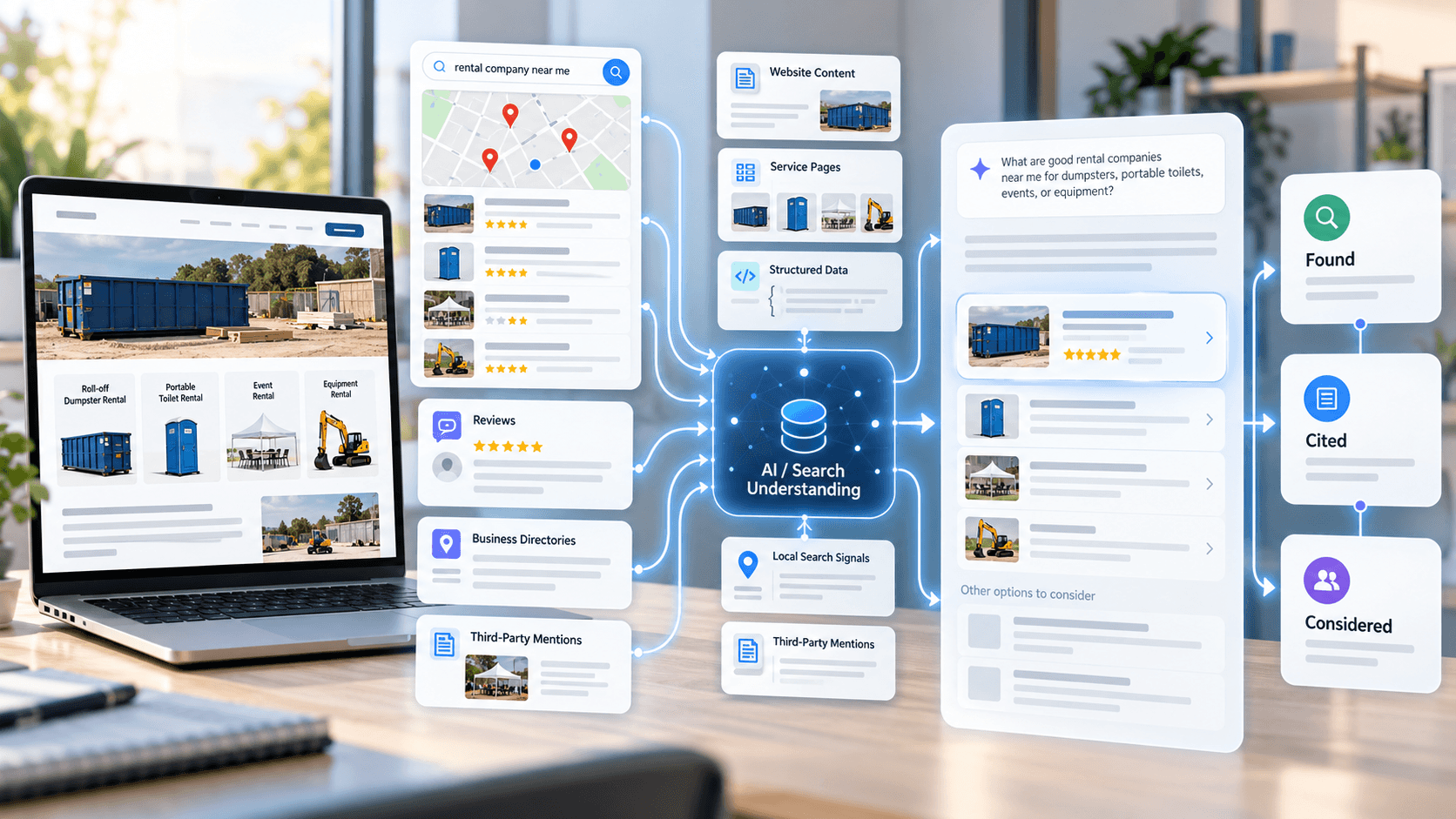
A rental company improves its chances of showing up in ChatGPT, Google AI Overviews, and similar tools the same way it improves traditional search visibility: clear website content, strong local and service pages, direct answers to real customer questions, reviews, consistent business information across the web, relevant external mentions, a crawlable site, and appropriate structured data.
AI search doesn't replace SEO — it depends on the same underlying fundamentals, plus a few additional habits worth building. No tactic on this page guarantees a citation from any AI tool; this is about improving the odds, not promising a result.
What Is AI Search Optimization for a Rental Company?
A few terms get used interchangeably here, and they overlap more than they differ:
- SEO (search engine optimization) — making a website easier for search engines to find, understand, and rank
- AEO (answer engine optimization) — structuring content so it can be directly extracted as an answer, by a search engine or an AI tool
- GEO (generative engine optimization) — a newer term for optimizing specifically for AI-generated answers and summaries
- AI search — the broad category of tools like ChatGPT, Google AI Overviews, and Perplexity that answer questions directly instead of just listing links
In practice, a rental company doesn't need a separate strategy for each term. They all reward roughly the same thing: a clear, trustworthy, well-structured source of information.
Does SEO Still Matter for ChatGPT and AI Search?
Yes. AI engines still need discoverable, understandable, trustworthy information to draw from — they don't conjure answers from nothing. Crawlability, page quality, topical relevance, authority, local relevance, and structured information all still matter.
SEO alone doesn't guarantee AI visibility, and nothing honestly can. But a site with weak SEO fundamentals is starting from a worse position with AI tools too, not a neutral one.
Start With a Clear Business Entity
Search engines and AI systems need to understand what a business actually is: its name, services, locations served, category, website, phone number, relevant business relationships, and what makes it distinct from similar companies nearby.
If your website can't clearly explain what you do, where you do it, and who you serve, an AI system isn't going to have an easier time figuring it out than a human visitor would. A dumpster company whose homepage never mentions dumpster rental, service area, or sizes — because it's all implied by a logo and a stock photo — is a real, common example of this problem.
Make Your Website Easy to Crawl and Understand
- Indexable pages with a clean, logical site structure
- Descriptive URLs rather than unlabeled strings of characters
- Consistent canonical tags so duplicate versions of a page don't compete with each other
- A working XML sitemap and a robots.txt that doesn't accidentally block important crawlers
- Readable HTML content — key information shouldn't be locked entirely behind JavaScript interactions where it can be avoided
This is intentionally basic. It's also the step most often skipped, usually because the site technically loads fine for a human sitting in front of it.
Create Strong Service Pages
Dumpster rental, portable toilet rental, restroom trailer rental, tent rental, equipment rental — each deserves its own page that clearly answers what the service is, who it's for, the service area, common use cases, how to request a quote, and a few relevant FAQs.
A single vague "services" page trying to cover everything tends to serve none of it well.
Create Useful City and Service-Area Pages
Local pages help both traditional local search and the context an AI system draws on. A useful one includes real service coverage, genuinely local detail, customer use cases, logistics considerations, a few honest FAQs, and links to relevant service pages.
Creating fifty thin pages by swapping in a new city name and calling it an AI strategy doesn't hold up — for a human reader or a system summarizing the page.
Answer the Questions Customers Actually Ask
This is one of the most extractable things a rental company's content can do. Real examples: how many dumpsters does a cleanout need, how many portable toilets does an event of a given size need, what size dumpster fits a kitchen remodel, how much notice is required, is a permit needed, what's the difference between a restroom trailer and a standard portable toilet, which equipment fits a specific project.
A reliable pattern: state the question, give a direct answer immediately, add supporting explanation and context, then a clear next step. Burying the answer under three paragraphs of preamble helps no one, including the reader.
Write Content in Clear, Self-Contained Sections
Descriptive headings, a direct first sentence, lists, comparisons, plain definitions, and FAQs all help a reader and an answer engine extract the right section without needing the rest of the page for context.
Bloated intros and vague marketing language do the opposite — they make a section harder to lift out and reuse as a direct answer.
Build Topical Authority Around Rental-Specific Problems
One article rarely does the job alone. Topic clusters tend to work better:
Dumpster rental
Lead generation, SEO, sizing, permits, pricing factors, service-area questions.
Portable toilets
SEO, event planning, construction needs, ADA requirements, hand-wash stations, restroom trailers.
Business growth
CRM, customer history, reviews, reactivation, speed-to-lead, tech stack.
This is the same reasoning behind the broader Rental Growth Systems resources library: specific, connected content across a category builds more topical depth than one standalone piece ever could.
Use Internal Links to Show Relationships Between Topics
- Industry pages should link to relevant service content
- Service content should link to deeper resource articles
- Resource articles should link to related resources and relevant solution pages
- No page should be orphaned — reachable only by typing its exact URL
Internal links help both human visitors and systems understand how topics on a site relate to each other, which is a meaningful part of establishing topical depth.
Why Reviews Matter for AI and Search Visibility
Reviews support trust, add local business context, reinforce reputation signals, build customer confidence, and factor into local search relevance. They're part of the broader public information footprint a business has — not a direct lever that causes an AI tool to cite a specific page.
See our guide on getting more Google reviews for the practical side of this.
Why Consistent Business Information Matters
Business name, phone number, website, service category, location and service area, hours, directory listings, and social or business profiles should all say the same thing everywhere they appear.
Conflicting information — an old phone number on one directory, a different service area on another — creates ambiguity that makes a business genuinely harder to describe with confidence, for a search engine, an AI system, or a customer.
Do Directories Help Rental Companies Show Up in AI Search?
Relevant, category-specific directories can help create third-party references, category context, service-area context, and additional discovery paths — categories like portable toilet or dumpster rental directories exist specifically to give customers and systems a way to compare providers in one place.
That's different from guaranteeing an AI citation. A directory listing is one data point among many, not a shortcut past everything else on this page.
Why Third-Party Mentions Matter
Industry directories, local associations, chambers of commerce, venue or contractor partner pages, sponsorships, local press, and mentions in genuinely useful resource content all add up to the same idea: consistent information appearing across multiple independent sources tends to build more confidence than a business only describing itself.
This matters at the margins, not as a single decisive factor — it's one more piece of a broader, honest public footprint.
See How Directory Visibility Works in Practice
This walkthrough shows how Rental Growth Systems features a real rental company across regional directory pages, city pages, and relevant resource content — the same kind of independent, third-party presence that search engines and AI tools draw context from.
What Role Does Structured Data Play?
Organization, WebSite, LocalBusiness where it's genuinely valid, Article, FAQ, and Breadcrumb schema all help clarify meaning and relationships in ways that are easier for machines to parse than plain prose alone.
Schema is helpful. It is not fairy dust — it helps a system interpret content that's already clear and useful; it doesn't manufacture authority or quality that isn't there in the first place.
Should a Rental Company Optimize for ChatGPT Specifically?
No — not as a standalone strategy. Adding "AI optimized" to a page title is not, unfortunately, a strategy, and content built narrowly for one platform tends to age poorly as these tools keep changing.
A stronger approach optimizes for clarity, authority, usefulness, entity consistency, crawlability, and real customer questions — a foundation that holds up across ChatGPT, Google AI, Perplexity, and whatever comes next, rather than chasing one platform's current behavior.
How Can a Rental Company Improve Its Chances of Being Cited by AI?
A few things genuinely improve the odds, without guaranteeing anything:
- Give direct answers to real questions, not vague overviews
- Publish original, genuinely useful content rather than reworded competitor copy
- Explain concepts clearly, with specific rental examples
- Keep facts current — outdated pricing or service details undermine trust
- Link related content so context is easy to follow
- Strengthen overall site authority over time
- Earn relevant third-party mentions where they make sense
- Keep business information consistent everywhere it appears
What Should a Rental Company Avoid?
- Keyword stuffing
- Thin, obviously AI-generated pages with no real substance
- Mass-produced location pages that only swap a city name
- Copied or lightly reworded competitor content
- Fake reviews
- Fake citations or fabricated sources
- Fake author credentials
- Exaggerated claims about results or guarantees
- Stuffing the brand name into content that doesn't need it
- Creating content written only for bots, with no real reader in mind
How Local SEO and AI Search Work Together
Local search
Google Business Profile, city and service pages, reviews, citations, and site authority.
AI search
Entity clarity, useful direct answers, topical depth, third-party context, and content that's easy to retrieve in clean passages.
The overlap is substantial — the same foundation of clear, accurate, well-structured information tends to support both at once, rather than requiring two separate efforts.
A Practical AI Visibility Checklist for Rental Companies
- Make sure the site is crawlable
- Clarify company, services, and locations served
- Strengthen core service pages
- Build genuinely useful city pages
- Answer customer questions directly
- Publish rental-specific content
- Improve internal linking
- Keep business information consistent everywhere
- Build legitimate reviews
- Earn relevant external mentions
- Use structured data appropriately
- Keep content current
- Track what search and AI tools are actually surfacing
How Do You Know If AI Search Visibility Is Improving?
There's no perfectly clean way to attribute a specific AI citation back to a specific tactic. Useful signals to watch instead: branded query growth, Search Console query trends, referral traffic where it's visible, customers mentioning they found the business through an AI tool, growing impressions on informational queries, and a widening set of topics the business shows up for.
What Should a Rental Company Work on First?
- Fix crawlability and technical basics
- Clarify entity and business information
- Strengthen core service pages
- Improve local pages
- Publish direct-answer resource content
- Strengthen reviews
- Build relevant external mentions
- Improve internal linking
- Add appropriate structured data
- Monitor and update over time
The Bottom Line
Rental companies don't need a separate "AI website." They need a clear, authoritative, useful digital presence that search engines and AI systems can understand just as well as a human customer can.
That's the same foundation behind Customer Acquisition, Digital Infrastructure, and Customer Value working together — visibility, systems, and relationships reinforcing each other rather than solving three unrelated problems.
Frequently Asked Questions
How can a rental company get found in ChatGPT?
By building the same fundamentals that support traditional SEO: a crawlable website, clear service and location pages, direct answers to real customer questions, consistent business information, reviews, and relevant third-party mentions. No tactic guarantees a specific citation.
Does SEO help a rental company appear in AI search?
Yes. AI search tools still rely on discoverable, understandable, trustworthy information, which is what SEO fundamentals are built to produce. SEO doesn't guarantee AI visibility, but weak SEO makes AI visibility harder too.
What is AEO for a rental company?
AEO, or answer engine optimization, means structuring content so it can be directly extracted as a clear answer — a direct response to a specific question, followed by supporting context, rather than information buried in a long, unstructured page.
Can Google reviews help with AI search visibility?
Reviews support trust, local relevance, and the broader public information footprint of a business, which can indirectly support AI visibility. Reviews don't directly cause an AI tool to cite a specific page.
Do business directories help rental companies appear in AI search?
Relevant, category-specific directories can add third-party context and discovery paths, which is useful. They don't guarantee an AI citation on their own — they're one data point among several.
Does schema markup help with ChatGPT or Google AI?
Structured data like Organization, LocalBusiness, Article, and FAQ schema helps clarify meaning and relationships for machines. It supports content that's already clear and useful — it doesn't replace good content or substitute for authority.
Can a rental company guarantee being cited by an AI tool?
No. No company can guarantee a citation or recommendation from ChatGPT, Google AI, Perplexity, or any other AI tool. The realistic goal is improving the odds through clear, authoritative, well-structured content — not guaranteeing a specific outcome.
What should a rental company optimize first for AI search?
Start with crawlability and basic technical health, then clarify business and entity information, strengthen core service and local pages, and publish content that answers real customer questions directly. Reviews, third-party mentions, and structured data build on that foundation.
Related Resources
Customer Acquisition
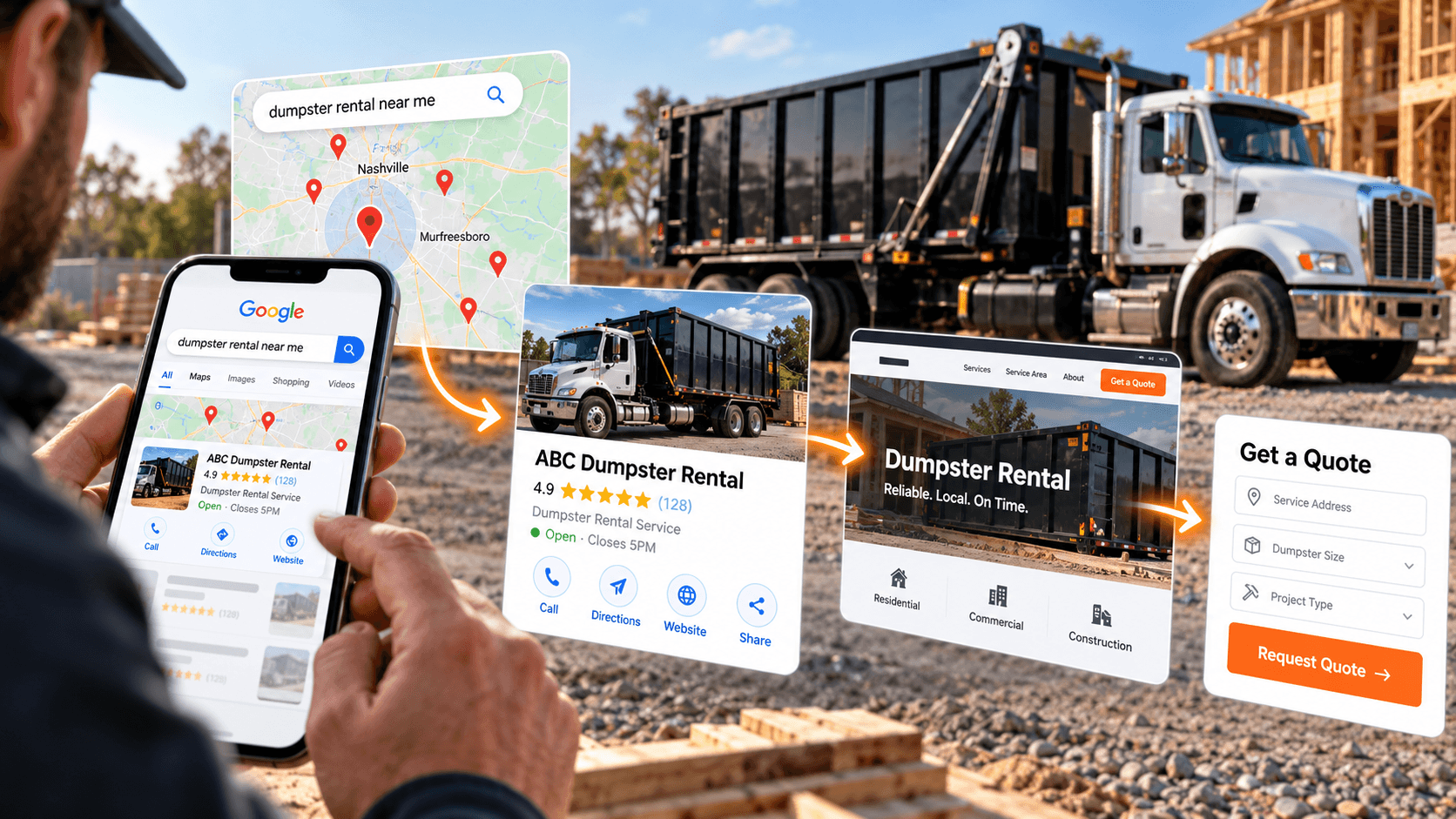
SEO for Dumpster Rental Companies: How to Rank in Google Maps and Local Search
What actually helps a dumpster rental company show up in Google Maps and local search — and why no single tactic does it alone.
Customer Acquisition
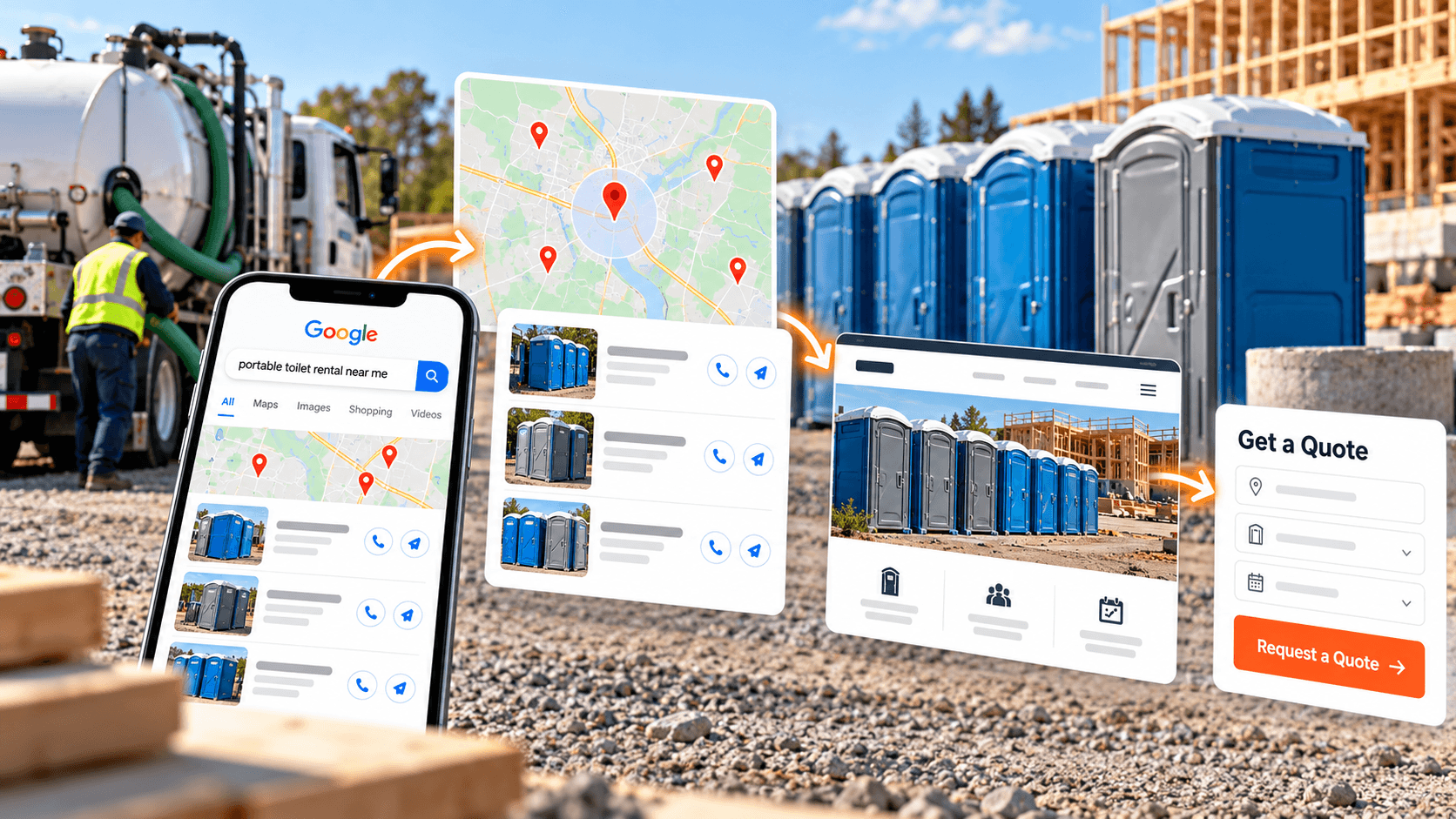
SEO for Portable Toilet Rental Companies: How to Rank in Google Maps and Local Search
What actually helps a portable toilet rental company show up in Google Maps and local search — and why no single tactic does it alone.
Digital Infrastructure
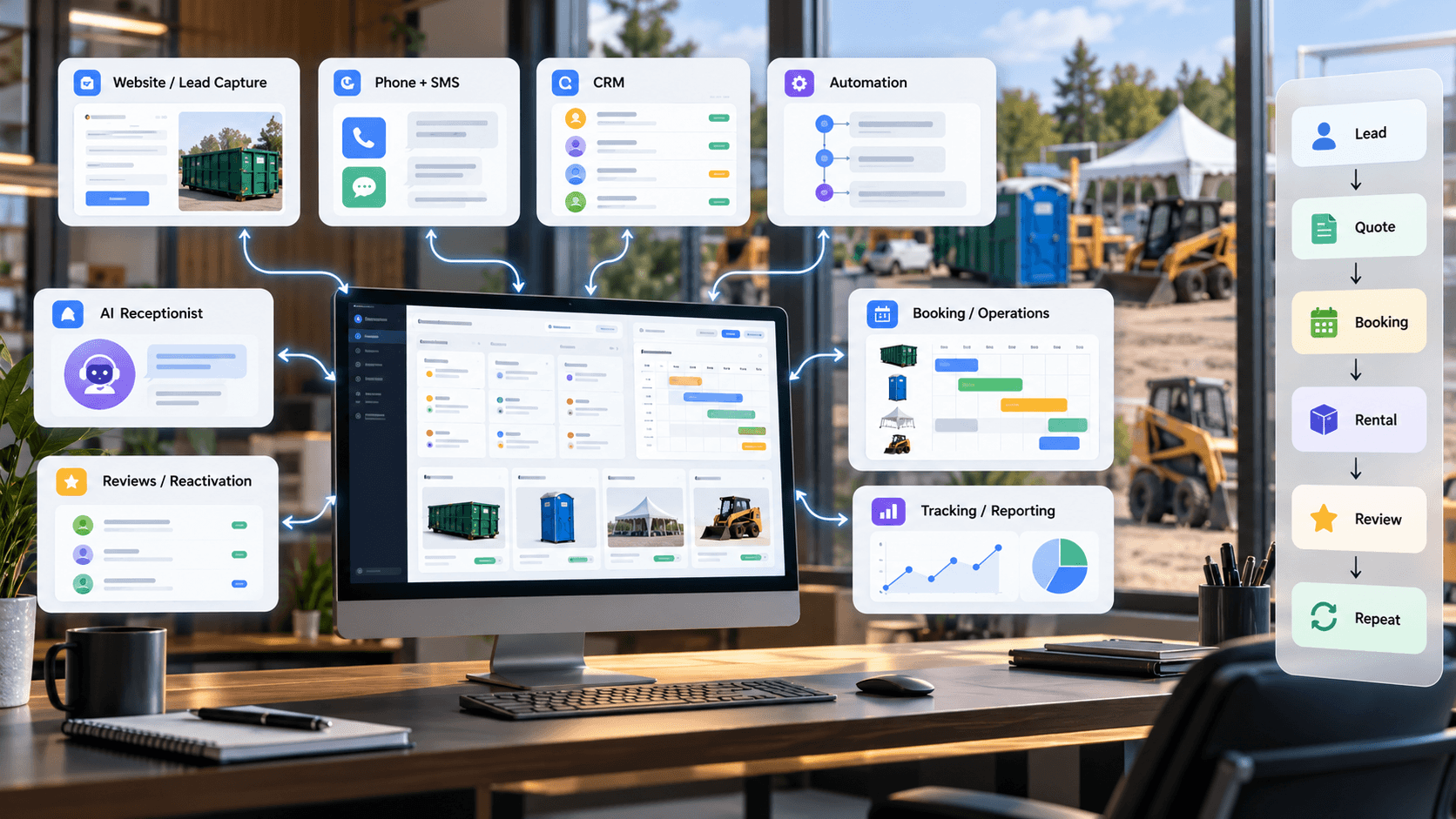
The Rental Business Tech Stack: CRM, Automation, AI, Tracking, and Growth Tools
What a rental company's technology actually needs to do — and why the right stack is the one where the pieces share information, not the one with the most tools.